 Board Up Royals
How Much Does Emergency Board Up Cost in Washington, DC?
Emergency board up in Washington costs anywhere from $220 to $1,080 on average to cover one to a few broken windows or a door with plywood. Here the price moves with the floor the opening is on, how tall an old row house window runs, the width of a downtown storefront, and whether the call comes at night. A vacant building also needs its plywood painted to match under District law, which adds a step, so tell us if the property is empty.
Do You Board Up Row Houses, Apartments, and Storefronts in Washington?
Yes, we board up row houses, detached homes, apartment and condo buildings, storefronts, offices and restaurants. Most homes here are attached or stacked. About 21 percent of homes are single-family row houses or townhouses and only about 11 percent are detached houses, so tell us what kind of building you're in when you call.
Which Washington, DC Neighborhoods Do You Cover?
We cover the whole District of Columbia, all eight wards. That takes in Georgetown, Foggy Bottom, Dupont Circle, Logan Circle, Shaw, U Street, Bloomingdale, LeDroit Park, Mount Pleasant, Cleveland Park, Woodley Park, Takoma Park, Capitol Hill, Kingman Park and Anacostia. Send us the street address and we'll confirm.
Do You Serve My ZIP Code in DC?
Yes, if the address has a District ZIP code, such as 20001, 20002, 20003, 20007, 20009, 20011, 20016, 20019, 20020 or 20032. If the property sits just over the line in Maryland or Virginia, send the address and we'll tell you whether we can reach it.
Can I Get a Board Up at Night or on a Weekend?
Yes, we take board up calls around the clock, weekends and holidays included. A night call often costs more, and we tell you the rate before a crew heads out.
How Fast Can a Crew Reach Me in Washington?
We usually arrive within one to two hours. The District covers only about 61 square miles, but it fits roughly 11,150 people into each one, so rush hour, street closures and parking matter more than distance. Event street closures downtown slow us further.
I Rent in DC. Who Has to Fix the Broken Window?
Your landlord does, in most cases. DOB says District landlords must keep windows and doors in working order. About 6 in 10 households here rent. Tell the landlord first. If nothing happens, DOB takes complaints after 10 days, or after 24 hours for an emergency such as no heat. We board up once the owner or manager approves.
What Causes Most Board Up Calls in Washington?
Break-ins, more than anything. The Metropolitan Police Department counted 718 burglaries in 2025, about two a day, and 717 by mid-November 2026. Many leave a smashed pane or a kicked-in door that has to be closed that night.
Does Homeowners Insurance Cover an Emergency Board Up?
Yes, often, when the damage behind it is a covered loss. The board up usually goes in as part of the claim, and your deductible applies. We photograph every opening before covering it and hand you an itemized invoice to send the adjuster.
What Should I Tell You When I Call?
Give us the address with any unit number, what broke, how many windows or doors are open, and which floor they're on. Tell us whether we can reach the back of a row house from an alley, and whether a front desk or manager has to let us in.
Do I Have to Be There While You Work?
No, as long as we have your approval and a way to reach the openings. A neighbor, building manager or relative can meet the crew. We settle access and payment with you before anyone arrives.
Does a Board Up Company Need a License in Washington, DC?
Yes, for paid repair work on homes. The DC Attorney General's office tells residents to check that a contractor is licensed with the Department of Licensing and Consumer Protection as a home improvement or general contractor. Licensed firms must be bonded and insured. Ask any company for its DC license number and look it up with DLCP.
Will I Get a Written Price Before You Start?
Yes, we confirm the price in writing before any boards go up. District rules say home improvement and general contractors need a contract signed by both sides before taking payment, and it has to show the contractor's District license number and the expected work dates. If we find more damage on site, we ask before doing it.
Can You Board Up a Downtown Storefront After a Break-In?
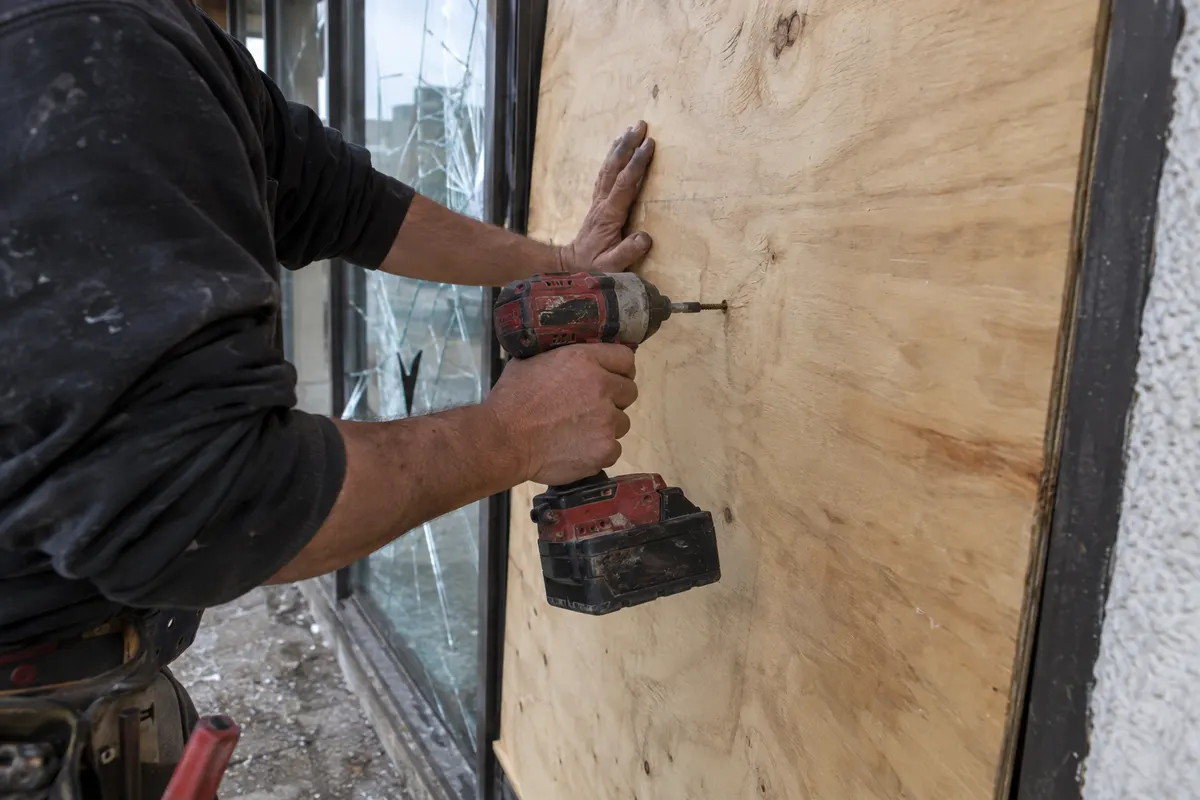
Yes, we close smashed display glass and doors the same night, joining plywood sheets over 2x4 braces at the seams. Downtown owners have been through it. In June 2020 more than 80 businesses had storefront glass damaged and 25 Golden Triangle businesses were looted. Send us the rough width and say whether the door is broken too.
Should My Business Board Up Before an Election or Protest in DC?
Yes, if your glass faces a likely gathering spot and replacing it would cost more than a few days behind plywood. In 2024 a local station reported downtown businesses boarding up for the third presidential election season in a row. Crews get busy across downtown that week, so book a few days ahead.
Can You Board Up Windows Broken in a Thunderstorm?
Yes, once the wind drops and it's safe to be on a ladder. NOAA's storm database lists 149 thunderstorm wind reports, 18 hail reports of an inch or larger and 4 tornadoes in the District from 2016 to 2025. A falling limb often takes out more than one window, so count them for us if you can do it safely.
Can You Board Up a Tall Window on an Old Row House?
Yes, we cut the plywood to the opening rather than forcing a stock sheet to fit. About 31 percent of DC homes were built before 1940, and windows that old often come in sizes no standard sheet matches, so a big one can take two pieces. Tell us the rough height and whether it's on the front or the back.
Can You Board Up a Window on a High Floor of an Apartment Building?
Yes, and here we usually work from inside the unit. Roughly 36 percent of District homes are in buildings with 50 or more units, well above ladder height. We pass the sheet out through the opening and brace it inside. Clear it with building management first, since many buildings set work hours and elevator rules.
Do I Need a Permit to Replace the Window After the Board Up?
Yes, in many cases. DC's Historic Preservation Office lists window replacement among the work that needs a building permit, which the Department of Buildings issues. Ask your window installer who pulls the permit, and plan how long the boards stay around that wait.
Does a Historic District in Washington Change How Long the Boards Stay Up?
Yes, it can. Washington has seventy historic districts, more than thirty of them neighborhoods such as Capitol Hill, Georgetown and LeDroit Park. Replacing a window there adds a preservation review to the permit. More than 95 percent of those reviews are expedited, but check before you order glass.
Can You Board Up a House After a Fire?
Yes, once fire officials release the building. We cover windows broken for ventilation, forced doors and holes cut in the roof. Be wary of anyone who shows up at the scene unasked, and get a written price from whoever you hire.
Can You Secure a Vacant House to Washington's Standard?
Yes, and the District spells that standard out. D.C. Code 42-3131.12 says broken or missing doors and windows on a vacant building must be covered with 1/2 inch CDX plywood that is tightly fitted, fastened with screws or bolts, weather protected and painted to match the building's main tone. We fit, fasten and paint to that.
Do I Have to Register a Vacant Building in DC?
Yes, once it has been vacant 90 days or more. DOB charges $350 to register and $500 to renew each year, and skipping it can bring fines of $1,000, $2,500 and $5,000. The registration also asks for a plan to keep the building secured, so keep our invoice and photos.
Will Boarding Up My Vacant House Raise the Property Tax?
Yes, it can. DC law lists missing or boarded-up windows and doors as a factor in calling a vacant building blighted, and DOB says blighted property is taxed at the Class 4 rate of 10 percent, against 5 percent for other vacant property. Boards close a building fast, but plan to get real windows back in.
Can the City Board Up My Vacant Building and Bill Me?
Yes, under D.C. Code 42-3131.01 the Mayor can close the open doors and windows of a vacant building right away and notify the owner afterward, then charge the cost as a tax on the property. DOB says money for this work is limited, so it picks its cases. Securing the building yourself first avoids that bill.
Will DOB Board Up a House After Squatters Leave?
Yes, in some cases. DOB doesn't remove squatters, which is a matter for the Metropolitan Police Department. Once they're out, if the house is still open and DOB finds it vacant, DOB will board and secure it. If you'd rather not wait, we can board it as soon as you confirm the occupants are gone.
Can a Board Up Cost More After a Declared Emergency in Washington, DC?
No, not beyond real cost increases. D.C. Code 28-4102 bars charging more than the normal price during a declared natural disaster or public emergency, unless the increase comes directly from higher supplier, labor or material costs. A disaster declaration under that law lasts up to 30 days.
How Long Does a Board Up Take?
One window usually takes an hour or two on site, cleanup included. A row house with a door and several broken windows typically takes 2 to 4 hours.
How Do I Report an Open Vacant Building Next Door?
Report it to DOB. First check the Vacant Properties tab on DOB's Public Dashboard to see if it's already listed, and if not, file DOB's vacant and blighted property report. DOB inspects, puts a sticker on the building if it finds it vacant, and sends the owner a notice to register.
